

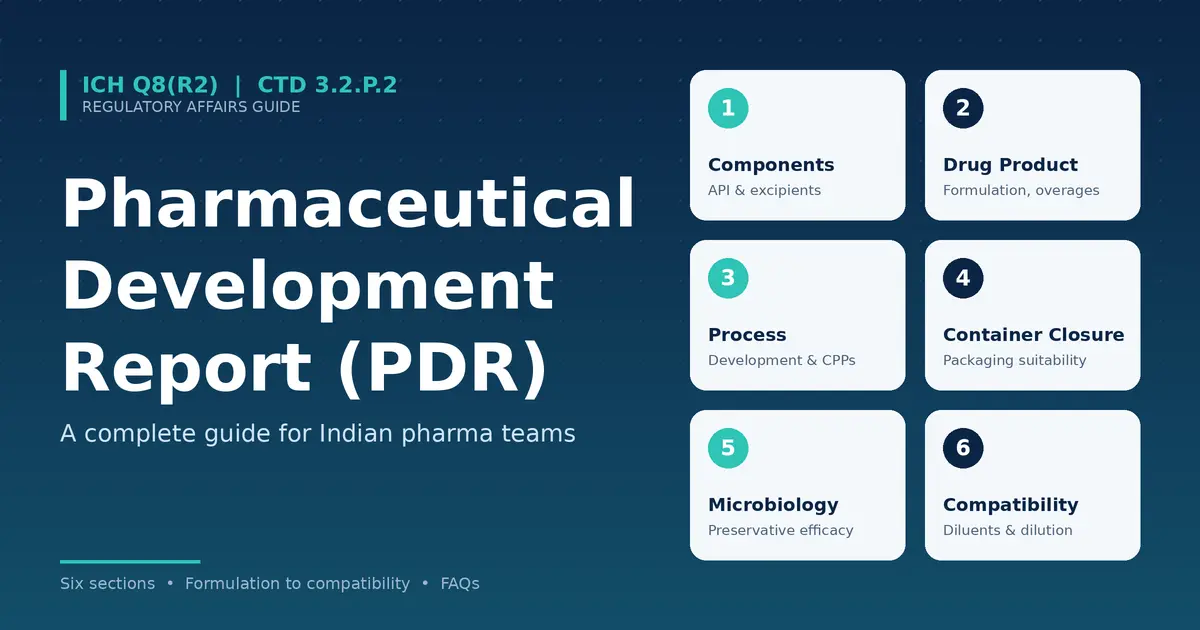
Pharmaceutical Development Report (PDR) is a technical document that explains the scientific and practical basis behind the development of a pharmaceutical product. It generally describes the formulation development process, selection of ingredients and their quantities, manufacturing process, critical quality attributes, compatibility studies, analytical methods, stability data, and the rationale for the final formulation.
What Is a Pharmaceutical Development Report (PDR)?
A Pharmaceutical Development Report is the document that explains how and why a drug product was designed the way it is. It presents the scientific knowledge gained during formulation and process development, supported by quality risk management, so that regulatory reviewers and inspectors can understand the product and its manufacturing process.
In the ICH CTD structure, this content is filed in Module 3 (Quality), section 3.2.P.2 “Pharmaceutical Development”, and is summarised in Module 2.3 (Quality Overall Summary).
The aim of pharmaceutical development, as ICH Q8 puts it, is to design a quality product and a manufacturing process that consistently delivers the intended performance. In simple terms, quality means the product is suitable and effective for its intended use.
Why the PDR Matters for Indian Manufacturers
India is one of the world’s largest suppliers of generic medicines, and many Indian companies file ANDAs with the US FDA and dossiers in the EU and other regulated markets. For these filers, a complete PDR:
- Helps reviewers understand the product quickly and reduces the number of queries.
- Justifies your formulation, process and specification choices with data.
- Supports a smoother pre-approval inspection, because inspectors compare your facility practice against what the PDR says.
- Provides the scientific basis for future post-approval changes.
The Six Sections of a PDR under ICH Q8
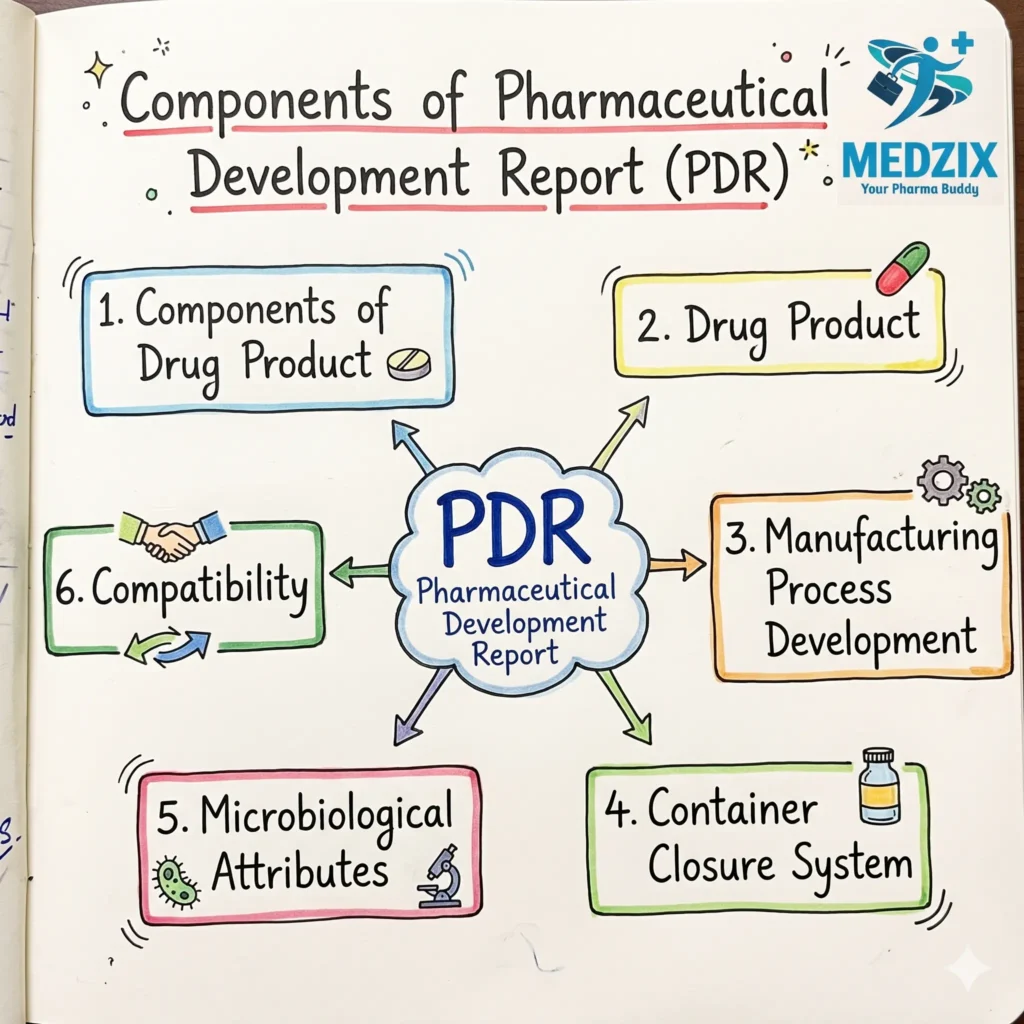
Q8 organizes pharmaceutical development into six parts. Many study notes list only five, so make sure your report covers all six.
- Components of the drug product
- Drug product
- Manufacturing process development
- Container closure system
- Microbiological attributes
- Compatibility
1. Components of the Drug Product
This section covers the drug substance (API) and the excipients.
Drug substance: Discuss the physicochemical and biological properties of the API that can affect product performance and manufacturability. Examples include:
- Solubility
- Water content
- Particle size
- Crystal properties (polymorphism)
- Biological activity
- Permeability
Other properties such as melting range may also be relevant, depending on the dosage form.
Excipients: Explain the choice of each excipient, its function and its amount, and discuss how it could influence performance or manufacturability. For functional excipients such as pH adjusters, buffers, stabilisers (antioxidants, chelating agents), preservatives and dissolution modifiers (for example surfactants), you should demonstrate that they perform their function throughout the intended shelf life.
2. Drug Product
This section has three parts.
2.1 Formulation development: This section summarize how the formulation evolved from early development to the proposed commercial formulation. Include:
- The formulations used in clinical safety and efficacy studies and in bioavailability or bioequivalence (BA/BE) studies.
- Any differences between those formulations and the proposed commercial formulation, with the rationale for each change.
- Comparative in vitro data (for example dissolution) or in vivo data (for example bioequivalence) linking clinical and commercial formulations, with study numbers cross-referenced.
- Any in vitro–in vivo correlation (IVIVC), if attempted. A successful IVIVC can help set dissolution acceptance criteria and may reduce the need for further bioequivalence studies after certain changes.
2.2 Overages: In general, using an overage of the drug substance to compensate for degradation during manufacture or shelf life, or to extend shelf life, is discouraged. If overages are used at any stage of manufacture, whether or not they appear in the final product, you must provide:
- The amount of overage
- The reason (for example, documented and expected manufacturing losses)
- The justification for that amount, considering safety and efficacy
The overage should be included in the drug substance quantity stated in the batch formula.
2.3 Physicochemical and biological properties: Identify and discuss the properties of the drug product that are relevant to its safety, performance or manufacturability, including the physiological implications of drug substance and formulation attributes.
3. Manufacturing Process Development
Explain why the commercial manufacturing process was selected, how it is controlled and how it was improved. You should:
- Link critical formulation attributes to the available process options.
- Justify the choice of equipment and process design.
- Identify critical process parameters (CPPs), and describe how they are monitored and controlled.
- Justify the drug product specifications.
- Describe differences between the process used for pivotal clinical batches, primary stability batches and commercial batches.
- Provide data showing the process is robust and reliably produces quality product.
4. Container Closure System
Discuss the suitability of the container closure system for storage, transportation (shipping) and use of the finished product. Cover:
- Choice of primary packaging materials
- Protection from moisture and light
- Compatibility with the dosage form, including sorption and leaching
- Safety of the materials of construction
- Justification for secondary packaging, where relevant
5. Microbiological Attributes
Where relevant, discuss:
- The selection and effectiveness of the preservative system, or the inherent antimicrobial activity of the product.
- For sterile products, the integrity of the container closure system in preventing microbial contamination.
- Justification of the lowest specified concentration of antimicrobial preservative, which should be the minimum that delivers the required efficacy throughout shelf life, supported by microbial test results.
Although routine specifications usually test chemical preservative content, antimicrobial preservative effectiveness must be demonstrated during development.
6. Compatibility
Address compatibility of the drug product with reconstitution diluents (for example precipitation or stability issues) and with admixture or dilution before administration (for example addition to large-volume infusion containers). This supports the labelling and should cover the recommended in-use shelf life, at the recommended storage temperature and at likely extremes of concentration.
Conclusion
The Pharmaceutical Development Report is more than a regulatory formality. It is the scientific story of your product. By following the six-part structure of ICH Q8(R2), supporting each choice with data and applying QbD thinking, Indian manufacturers can submit stronger dossiers, face fewer reviewer queries and build credibility with regulators worldwide.
Frequently Asked Questions (FAQs)
1. What does PDR stand for in pharma?
In regulatory affairs, PDR stands for Pharmaceutical Development Report. It is filed in CTD section 3.2.P.2.
2. Which guideline governs the Pharmaceutical Development Report?
ICH Q8(R2) – Pharmaceutical Development. It incorporates the earlier Q8 and Q8(R1) content.
3. How many sections does a PDR have according to ICH Q8?
Six: components of the drug product, drug product, manufacturing process development, container closure system, microbiological attributes and compatibility.
4. Where is the PDR located in the CTD?
In Module 3 (Quality), section 3.2.P.2, with a summary in Module 2.3 (QOS).