

Do you want to increase engagement on Facebook page? The competition on social media platforms has increased dramatically. People are launching new brands and using multiple ways to improve their sales and build an audience.
To give other pages a tough time, you need to present your content in a unique way.
You may spend hours creating a Facebook post, but in the end, your analytics show very little engagement. No likes, comments or shares for the posts. It can be disappointing when all your efforts seem to go in vain.
Have you ever thought about why this happens? Why don’t people stop to read your post or interact with your page?
There can be many reasons, but one of them is poor copywriting. Without improving the way you write your Facebook posts, it can be difficult to grab people’s attention and encourage them to interact with your content.
In this article, we will discuss some important copywriting techniques that you should remember while writing content for your Facebook page. These tips can help you make your posts more interesting, understandable, and engaging.
7 Copywriting Tips to Increase Engagement on Facebook
In this section, we are going to discuss some effective copywriting tips that can make your Facebook posts more appealing and encourage your audience to interact with them.
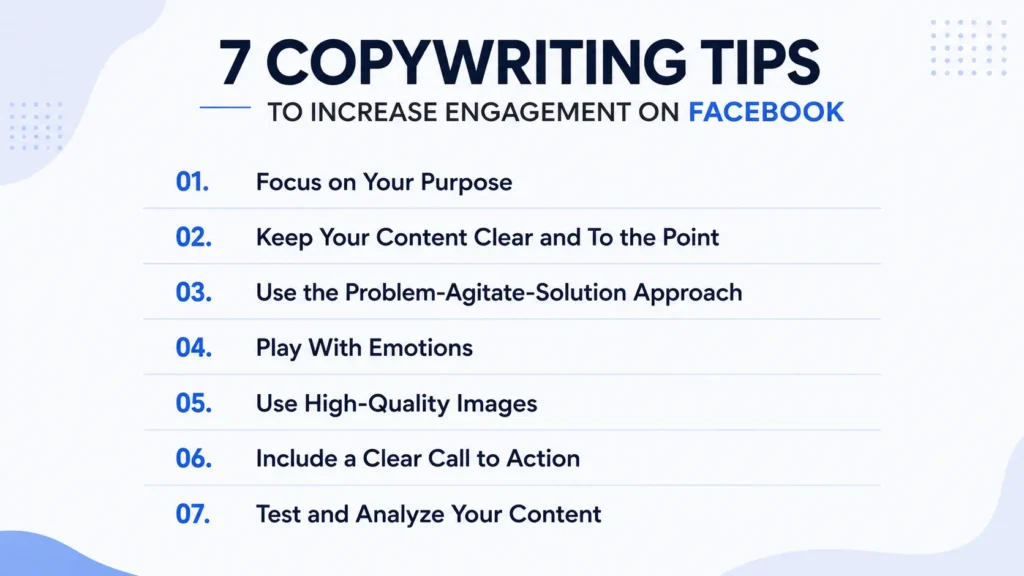
1. Focus on Your Purpose
Before starting to write on a topic, it is necessary to understand what you want to achieve with the post. Are you trying to promote a product? Share useful information? Get comments from your audience? Send people to your website? Or simply entertain them? Without a clear purpose, you may include unnecessary information that can distract your audience.
Therefore, it is quite important to understand the main purpose of the post and stick with it till the end. Don’t try to discuss too many different things in one post. Keep the message focused so that readers can easily understand what you are trying to say.
For example, if your goal is to encourage people to visit your website, make that action clear instead of filling the post with unrelated information.
Related Article: What Does ISO Mean on Facebook?
2. Keep Your Content Clear and To the Point
Some writers use the technique of increasing the length of their content to make it look more informative. But longer doesn’t always mean better. People scrolling through Facebook usually want to understand the main idea quickly. If your post takes too long to get to the point, they may simply scroll past it.
So, the thing is that you have to keep your writing clear and to the point. Use short paragraphs and simple sentences. Highlight the most important information instead of adding unnecessary words just to make the post longer.
You can also use an online word-count tool while preparing your content. It can help you keep an eye on the length of your post and make unnecessary sections easier to identify. The same applies to keywords. Don’t try to insert the same keyword repeatedly just to improve SEO. Write naturally for your audience first.
📌Bonus: Free and best Wordcounter Tool – https://wordcounter.net/
3. Use the Problem-Agitate-Solution Approach
Marketing strategies have been changing drastically over the years because of the adoption of technology. But one thing that continues to work is the Problem-Agitate-Solution (PAS) approach.
The idea is simple. First, identify a problem that your audience is facing. Then explain why that problem is frustrating or important. Finally, provide a solution.
For example, suppose you sell a tool that helps people schedule their social media posts. Instead of simply writing: “Our social media scheduling tool is easy to use.”
You could write: “Tired of spending every evening publishing social media posts manually? Missing a post can affect your consistency. With our scheduling tool, you can prepare your posts in advance and let them publish automatically.”
The second example talks about the problem before presenting the solution. This gives the reader a reason to continue reading.
4. Play With Emotions
People don’t interact with every post they see on Facebook. A post needs to give them a reason to stop scrolling. One way to do that is by connecting with the emotions of your audience. You can use storytelling, humor, curiosity, excitement, surprise or even empathy depending on the type of content you are creating.
But remember that playing with emotions doesn’t mean exaggerating everything. You have to tell the story in a creative and genuine way. You could share a short story about a problem your customers faced and how the product helped them solve it.
Stories feel more personal, and personal content can make it easier for people to connect with your message.
5. Use High-Quality Images
You can never ignore the importance of visuals on social media. Some professionals compare images in content to sauces on pizza. If you’re missing this element, there may be fewer reasons for people to stop and look at your post.
It should be among your common practices to use high-quality images that are related to the topic. A relevant image can give the audience an idea about the intent of your post and make the content easier to understand.
However, don’t use an image simply because you need an image. The visual should support your message.
6. Add Social Proof and Testimonials
Praising your own products isn’t always the best way to build trust. When you repeatedly tell people how amazing your product is, some readers may naturally become skeptical. A better way to build trust is by showing what other customers think about your product or service.
This is where testimonials and social proof can help. You can include:
- Customer reviews
- Testimonials
- User experiences
- Before-and-after results
- Ratings or feedback
- Real examples of how customers use your product
You could share an actual customer experience explaining how the product helped them. Of course, make sure that testimonials and results are genuine. Don’t create fake reviews just to make your Facebook post look more convincing.
7. Add a Clear Call to Action
Last but not least, add a Call to Action (CTA) to your Facebook post when appropriate. Many people make the mistake of creating attractive content but forgetting to tell the audience what they should do next.
You may have successfully grabbed someone’s attention, but what happens after they finish reading your post? That’s where a CTA comes in. Your CTA doesn’t always have to be about making a sale. Sometimes, simply encouraging a conversation can increase engagement.
How to Write a Facebook Post That Gets More Engagement
The seven copywriting tips above can become much more effective when you combine them instead of using them individually.
For example, imagine you’re promoting a product.
You could start by describing a problem your audience faces, explain why it’s frustrating, introduce your product as a solution, add a genuine customer testimonial, use an attractive image and finish with a simple CTA.
This creates a complete Facebook post instead of simply listing the features of your product. Remember, your goal shouldn’t be to make every post sound like an advertisement. Write for people first.
Conclusion
If you are looking to increase engagement on your Facebook page, you must improve the content in your posts. Your copywriting style should be attractive enough to make people stop scrolling and clear enough to help them understand the purpose of your post.
You don’t need to use complicated words or write extremely long posts. Sometimes, a simple message that understands the audience can perform much better than a complicated one. The most important things are to keep your writing focused, understand the problem you’re solving, connect with your audience, use relevant visuals, provide social proof and add a clear CTA when necessary.
Try these copywriting techniques in your next Facebook post and see which ones work best for your audience.
Frequently Asked Questions
How can copywriting increase Facebook engagement?
Good copywriting can make your Facebook posts easier to understand and more interesting to read. A clear message, engaging opening, relevant visuals and a suitable CTA can encourage people to stop scrolling, react, comment, share, or visit your website.
What should I write in a Facebook post to get more comments?
Ask your audience a simple and relevant question related to the topic of your post. Questions that encourage people to share their opinions or experiences can help start conversations.
Should Facebook posts be short or long?
There is no single ideal length for every Facebook post. The important thing is to provide the necessary information without adding unnecessary words. Keep the post as long as it needs to be and as short as possible.
What is a CTA on Facebook?
CTA stands for Call to Action. It tells your audience what you want them to do next, such as comment, share, visit a website, send a message or check out a product.
Should I use emotional language in Facebook posts?
Emotional storytelling can make content more relatable, but it should feel natural and genuine. Avoid exaggerated claims or emotional manipulation simply to get clicks or engagement.